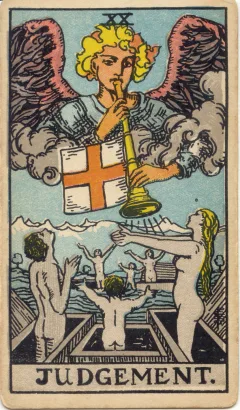
Overview and symbolism
Figures rise and look toward a large sound-bearing figure above them, creating a scene of attention and response. Read the image as a metaphor for becoming aware of something that deserves an answer. Judgement concerns reflection and renewal. It asks how you can review experience honestly without reducing yourself or anyone else to a single past decision.
Keywords
- Upright: reflection, renewal.
- Reversed: self-criticism, avoidance.
Upright meaning
Reflection becomes useful when it leads to a clearer understanding of responsibility and possibility. Consider what an earlier choice taught you, what effects remain, and what you would do differently now. Renewal need not erase the past. It can mean responding to it with greater awareness and a practical commitment you are prepared to keep.
Reversed meaning
Self-criticism and avoidance can prevent a fair review. One keeps replaying the mistake as proof of inadequacy; the other refuses to examine it at all. Try describing the event in specific terms and separating the action from your whole identity. That distinction leaves room for an apology, a repair, or a changed approach.
Love
An old pattern may deserve a fresh conversation, but renewal requires participation from both people. Acknowledging your part does not entitle you to forgiveness or renewed contact. Respect the other person's response while deciding which changes you can make independently.
Career
A retrospective can improve future work if it identifies concrete lessons and assigns realistic follow up. Avoid using the review to distribute shame or produce vague promises. Name the process that needs to change and what evidence would show that the change has been adopted.
Advice
Write a brief review of one experience: what happened, what you learned, and what you can do differently. Leave out labels about being a good or bad person. Choose a response proportionate to the actual impact rather than to the intensity of your embarrassment.
Yes or No
- Upright — Yes: reflection, renewal.
- Reversed — Maybe: self-criticism, avoidance.
This guide uses a fixed mapping for each orientation. Compare the listed themes with your question: where do they describe a practical opening, an obstacle, or missing information? Write down the observation that best supports your interpretation, along with any detail you still need to check.
Related spreads
Try a daily one-card reading with this prompt: "What lesson am I ready to answer with a concrete change?" Write an observation from your day beside the card's theme, then choose one small action if it feels useful.
A three-card reading can add context through past, present, and future positions. Use the future position to explore how different choices could develop from your current circumstances. For a more layered question, try the Celtic Cross to compare influences and perspectives. With the Yes or No spread, start with a focused question, then compare the fixed tendency above with your own observations.
FAQ
Is Judgement a punishment card?
No. It is used here for reflection and renewal, not punishment. The emphasis is on understanding experience and choosing an accountable response without turning a past action into a permanent identity.
What does Judgement reversed mean?
The reversed themes are self-criticism, avoidance. Use them to examine the situation from another angle. A reversal can highlight a difficulty, an adjustment, or a constructive response. Choose the interpretation that fits your observations and the position in the spread.
What question can I ask with Judgement?
Ask: "What lesson am I ready to answer with a concrete change?" Keep the answer connected to your own observations and choices. If the interpretation does not fit, you can set it aside rather than forcing your experience to match the card.
This AI-assisted interpretation is for entertainment only and does not predict the future. It is not medical, legal, or investment advice.