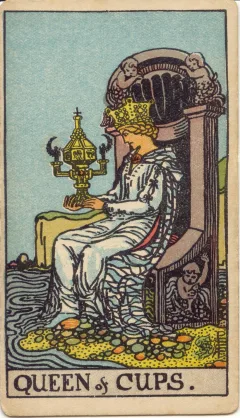
Overview and symbolism
A seated figure studies an ornate closed cup beside the water, with the shore and elaborate seat framing a quiet scene. The attention is inward and sustained. The Queen of Cups explores empathy and inner calm. Its court role can describe how anyone listens and responds, rather than a fixed personality or a person of a particular gender.
Keywords
- Upright: empathy, inner calm.
- Reversed: overgiving, blurred boundaries.
Upright meaning
Empathy involves trying to understand another person's experience while remembering that it remains theirs. Listen for what they actually say and ask before interpreting. Inner calm does not require having no feelings; it can mean giving a response enough space to become deliberate. You can be moved by someone else's experience without immediately taking responsibility for resolving it.
Reversed meaning
Overgiving and blurred boundaries may make care feel exhausting or compulsory. Notice where you have agreed to more emotional availability than you can sustain. A boundary can preserve warmth by making the offer honest. The reversal invites you to distinguish listening, helping, and assuming responsibility, rather than treating all three as the same obligation.
Love
Ask whether the other person wants listening, practical help, or space before responding. Share your own needs as well. A relationship becomes uneven when one person is always the interpreter and caretaker while their feelings remain unspoken or assumed to be less important.
Career
A thoughtful listener can improve a difficult discussion, but workplace empathy still needs clear roles. Acknowledge a colleague's concern and identify the part you can appropriately help with. You do not need to become the private support system for every person around you.
Advice
During one conversation, reflect back what you heard and ask whether you understood correctly. Then check your own capacity before offering more. This keeps empathy anchored in the person's actual words and in a realistic account of what you can provide.
Yes or No
- Upright — Yes: empathy, inner calm.
- Reversed — Maybe: overgiving, blurred boundaries.
This guide uses a fixed mapping for each orientation. Compare the listed themes with your question: where do they describe a practical opening, an obstacle, or missing information? Write down the observation that best supports your interpretation, along with any detail you still need to check.
Related spreads
Try a daily one-card reading with this prompt: "How can I listen closely while keeping both people's needs visible?" Write an observation from your day beside the card's theme, then choose one small action if it feels useful.
A three-card reading can add context through past, present, and future positions. Use the future position to explore how different choices could develop from your current circumstances. For a more layered question, try the Celtic Cross to compare influences and perspectives. With the Yes or No spread, start with a focused question, then compare the fixed tendency above with your own observations.
FAQ
Does the Queen of Cups mean I should trust every feeling about someone?
No. Sensitivity can guide a question, but it does not reveal another person's private thoughts. Check impressions through respectful conversation and distinguish your own response from what the other person has said.
What does Queen of Cups reversed mean?
The reversed themes are overgiving, blurred boundaries. Use them to examine the situation from another angle. A reversal can highlight a difficulty, an adjustment, or a constructive response. Choose the interpretation that fits your observations and the position in the spread.
What question can I ask with Queen of Cups?
Ask: "How can I listen closely while keeping both people's needs visible?" Keep the answer connected to your own observations and choices. If the interpretation does not fit, you can set it aside rather than forcing your experience to match the card.
This AI-assisted interpretation is for entertainment only and does not predict the future. It is not medical, legal, or investment advice.