Overview and symbolism
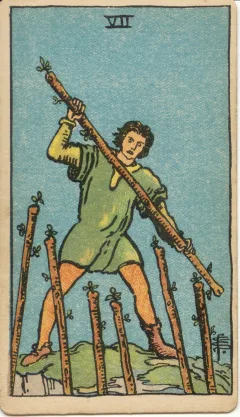
A figure stands on higher ground holding a wand across the body while several wands rise from below. The uneven stance gives the scene a sense of responding under pressure. The Seven of Wands concerns conviction and boundaries. It asks which position deserves your effort and how to defend it without assuming that every question is an attack.
Keywords
- Upright: conviction, boundaries.
- Reversed: overwhelm, defensiveness.
Upright meaning
Conviction is easier to communicate when you can explain the value or responsibility behind it. A boundary might protect time, a standard of work, or an agreed limit. State it clearly and keep the response proportionate. You do not need to win every exchange to maintain a position you have considered carefully.
Reversed meaning
Overwhelm and defensiveness may indicate that too many issues have been treated as equally urgent. Consider where a genuine boundary is needed and where clarification would be enough. If you feel constantly challenged, review the demands rather than judging yourself for not handling all of them. Selective engagement can preserve attention for what actually matters.
Love
Say what you are comfortable with and what you are not, without making the boundary a punishment. A partner or friend can disagree while still respecting it. Notice whether you are responding to the current request or defending against a pattern from an earlier experience.
Career
Protect an agreed priority by explaining what another request would displace. A reasoned boundary gives colleagues useful information. If feedback feels threatening, ask for a concrete example before defending the whole project; the issue may be narrower than it first sounds.
Advice
Choose one boundary that matters today and write it as a clear statement of your availability or responsibility. Remove explanations that are only attempts to gain universal approval. Decide which follow up question you can answer calmly if the boundary is challenged.
Yes or No
- Upright — Yes: conviction, boundaries.
- Reversed — No: overwhelm, defensiveness.
This guide uses a fixed mapping for each orientation. Compare the listed themes with your question: where do they describe a practical opening, an obstacle, or missing information? Write down the observation that best supports your interpretation, along with any detail you still need to check.
Related spreads
Try a daily one-card reading with this prompt: "Which position is worth defending, and which argument can I leave alone?" Write an observation from your day beside the card's theme, then choose one small action if it feels useful.
A three-card reading can add context through past, present, and future positions. Use the future position to explore how different choices could develop from your current circumstances. For a more layered question, try the Celtic Cross to compare influences and perspectives. With the Yes or No spread, start with a focused question, then compare the fixed tendency above with your own observations.
FAQ
Does the Seven of Wands mean everyone is against me?
No. Its image of pressure is a metaphor, not evidence about other people's intentions. Examine actual requests and disagreements before deciding where a firm boundary is needed.
What does Seven of Wands reversed mean?
The reversed themes are overwhelm, defensiveness. Use them to examine the situation from another angle. A reversal can highlight a difficulty, an adjustment, or a constructive response. Choose the interpretation that fits your observations and the position in the spread.
What question can I ask with Seven of Wands?
Ask: "Which position is worth defending, and which argument can I leave alone?" Keep the answer connected to your own observations and choices. If the interpretation does not fit, you can set it aside rather than forcing your experience to match the card.
This AI-assisted interpretation is for entertainment only and does not predict the future. It is not medical, legal, or investment advice.