Overview and symbolism
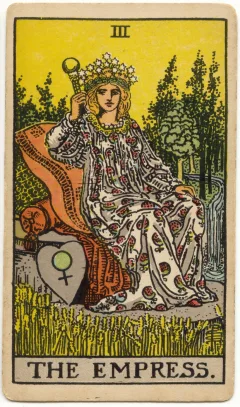
A seated figure rests among cushions, grain, trees, and flowing water. The landscape presents growth as something supported by an environment, not forced by a command. The Empress connects creativity with nurture: ideas, relationships, and ordinary routines need conditions in which they can develop. The abundance of the scene can be read as an invitation to notice care that is already present.
Keywords
- Upright: creativity, nurture.
- Reversed: dependence, neglect.
Upright meaning
Creativity may be a drawing, a meal, a welcoming room, or a more considerate way of arranging a shared task. Nurture means paying attention to what helps something grow at its own pace. Consider whether your project needs encouragement, a better workspace, or time protected from interruption before you judge the quality of its early results.
Reversed meaning
Dependence and neglect ask whether care has become uneven. You might be doing everything for someone while overlooking your own needs, or expecting an idea to flourish without giving it attention. The reversal offers a chance to adjust the conditions. It does not imply that you must become endlessly available or take responsibility for every difficulty nearby.
Love
Express affection in a form the other person actually welcomes. Listening, practical help, and shared ease can matter more than an elaborate gesture. Care remains mutual when both people can ask for space and acknowledge the effort involved in supporting one another.
Career
A creative process benefits from usable resources and feedback that identifies what is working. Before requesting more output, examine whether the team has time to develop an idea. Support can mean protecting a drafting session or making instructions clearer, rather than praising people while leaving them unsupported.
Advice
Choose one neglected condition you can improve: light at a desk, time for a hobby, or a calmer shared routine. Make the improvement modest and sustainable. Notice whether it helps you engage with the activity more willingly.
Yes or No
- Upright — Yes: creativity, nurture.
- Reversed — Maybe: dependence, neglect.
This guide uses a fixed mapping for each orientation. Compare the listed themes with your question: where do they describe a practical opening, an obstacle, or missing information? Write down the observation that best supports your interpretation, along with any detail you still need to check.
Related spreads
Try a daily one-card reading with this prompt: "What conditions would help this idea or relationship feel supported?" Write an observation from your day beside the card's theme, then choose one small action if it feels useful.
A three-card reading can add context through past, present, and future positions. Use the future position to explore how different choices could develop from your current circumstances. For a more layered question, try the Celtic Cross to compare influences and perspectives. With the Yes or No spread, start with a focused question, then compare the fixed tendency above with your own observations.
FAQ
Does The Empress indicate pregnancy?
No. Here its growth imagery describes creativity and care, not a health or pregnancy prediction. Questions about reproductive health belong with a qualified healthcare professional, not a card interpretation.
What does The Empress reversed mean?
The reversed themes are dependence, neglect. Use them to examine the situation from another angle. A reversal can highlight a difficulty, an adjustment, or a constructive response. Choose the interpretation that fits your observations and the position in the spread.
What question can I ask with The Empress?
Ask: "What conditions would help this idea or relationship feel supported?" Keep the answer connected to your own observations and choices. If the interpretation does not fit, you can set it aside rather than forcing your experience to match the card.
This AI-assisted interpretation is for entertainment only and does not predict the future. It is not medical, legal, or investment advice.