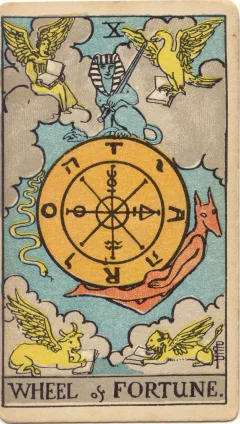
Overview and symbolism
A large wheel dominates the image, surrounded by figures and creatures arranged around its turning form. The composition places movement beside the attempt to understand it. Wheel of Fortune explores cycles and adaptability: plans meet changing circumstances, and a familiar pattern may look different when viewed from another position. The wheel is a metaphor for change, not a mechanism revealing fate.
Keywords
- Upright: cycles, adaptability.
- Reversed: resistance, instability.
Upright meaning
Notice recurring phases in a project, a routine, or your own interest. Some moments favor starting, while others require maintenance or revision. Adaptability means recognizing the phase you are actually in instead of insisting that every day support the same kind of effort. Ask which response remains available even when you cannot choose all the conditions.
Reversed meaning
Resistance and instability may arise when a familiar arrangement no longer holds. Trying to restore every detail can consume attention without addressing what has changed. Identify what is still dependable, what needs a revised expectation, and what remains unknown. Small adjustments can make a changing situation more understandable without pretending that you control the whole cycle.
Love
Relationships move through different rhythms of closeness, routine, and change. Discuss how current circumstances affect your time and attention. A shift in rhythm need not be assigned a dramatic meaning; it may simply call for an updated agreement about how you stay connected.
Career
Changing priorities can make an old plan less useful. Review assumptions with the people involved and preserve work that remains relevant. Agree on a review point and decide which parts of the process can change without losing the purpose or leaving colleagues unclear about their responsibilities.
Advice
Map a recent repeating pattern using three stages: what starts it, what sustains it, and what ends it. Choose one stage where your response is adjustable. Work with that point instead of trying to direct every surrounding event.
Yes or No
- Upright — Yes: cycles, adaptability.
- Reversed — Maybe: resistance, instability.
This guide uses a fixed mapping for each orientation. Compare the listed themes with your question: where do they describe a practical opening, an obstacle, or missing information? Write down the observation that best supports your interpretation, along with any detail you still need to check.
Related spreads
Try a daily one-card reading with this prompt: "Which part of this cycle can I respond to differently?" Write an observation from your day beside the card's theme, then choose one small action if it feels useful.
A three-card reading can add context through past, present, and future positions. Use the future position to explore how different choices could develop from your current circumstances. For a more layered question, try the Celtic Cross to compare influences and perspectives. With the Yes or No spread, start with a focused question, then compare the fixed tendency above with your own observations.
FAQ
Does Wheel of Fortune predict good luck?
No. Its fixed Yes tendency reflects adaptability in this guide, not a forecast of luck. Use the wheel to examine how you respond to changing conditions and recurring patterns.
What does Wheel of Fortune reversed mean?
The reversed themes are resistance, instability. Use them to examine the situation from another angle. A reversal can highlight a difficulty, an adjustment, or a constructive response. Choose the interpretation that fits your observations and the position in the spread.
What question can I ask with Wheel of Fortune?
Ask: "Which part of this cycle can I respond to differently?" Keep the answer connected to your own observations and choices. If the interpretation does not fit, you can set it aside rather than forcing your experience to match the card.
This AI-assisted interpretation is for entertainment only and does not predict the future. It is not medical, legal, or investment advice.