Overview and symbolism
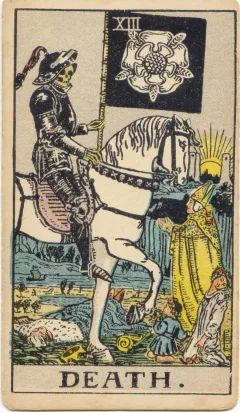
An armored rider moves through a scene of figures responding differently to an unmistakable transition, while light appears on the distant horizon. The stark contrast makes this an arresting card. The title gives a stark name to the experience of endings and transition. The image asks what it takes to recognize that a form, role, or routine no longer fits.
Keywords
- Upright: endings, transition.
- Reversed: stagnation, clinging.
Upright meaning
An ending can be ordinary: finishing a course, retiring an unused process, or acknowledging that an old expectation is no longer realistic. Transition includes the space between the familiar arrangement and the next one. Give that space a name instead of rushing to fill it. Closing something carefully can preserve what you learned without requiring you to keep repeating it.
Reversed meaning
Stagnation and clinging describe the effort of maintaining something mainly because it used to matter. Consider what you are trying to preserve: the activity itself, a sense of identity, or the comfort of familiarity. A small acknowledgment may be enough to begin. You do not have to force a dramatic break to admit that your needs have changed.
Love
A relationship may need an outdated pattern to end, such as guessing at needs or repeating an unhelpful argument. Start by naming one pattern you both recognize. Discuss the behavior that needs to change and whether both people are willing to participate in a different approach.
Career
Complete a handover, retire an obsolete document, or make a clear distinction between a finished phase and continuing work. Closure helps others understand what remains active. Ask which responsibilities continue after the transition and who needs a clear handover to carry them forward.
Advice
Choose one completed or outgrown item and give it a deliberate ending. Archive it, thank someone involved, or write what it taught you. Then name the immediate practical need created by letting it go, without demanding a complete new identity.
Yes or No
- Upright — No: endings, transition.
- Reversed — Maybe: stagnation, clinging.
This guide uses a fixed mapping for each orientation. Compare the listed themes with your question: where do they describe a practical opening, an obstacle, or missing information? Write down the observation that best supports your interpretation, along with any detail you still need to check.
Related spreads
Try a daily one-card reading with this prompt: "What has run its course, and what would respectful closure involve?" Write an observation from your day beside the card's theme, then choose one small action if it feels useful.
A three-card reading can add context through past, present, and future positions. Use the future position to explore how different choices could develop from your current circumstances. For a more layered question, try the Celtic Cross to compare influences and perspectives. With the Yes or No spread, start with a focused question, then compare the fixed tendency above with your own observations.
FAQ
Does the Death card predict an actual death?
No. Death is used here only as a metaphor for endings and transition. It cannot predict a death, illness, or other event, and should never be treated as a health warning.
What does Death reversed mean?
The reversed themes are stagnation, clinging. Use them to examine the situation from another angle. A reversal can highlight a difficulty, an adjustment, or a constructive response. Choose the interpretation that fits your observations and the position in the spread.
What question can I ask with Death?
Ask: "What has run its course, and what would respectful closure involve?" Keep the answer connected to your own observations and choices. If the interpretation does not fit, you can set it aside rather than forcing your experience to match the card.
This AI-assisted interpretation is for entertainment only and does not predict the future. It is not medical, legal, or investment advice.