Overview and symbolism
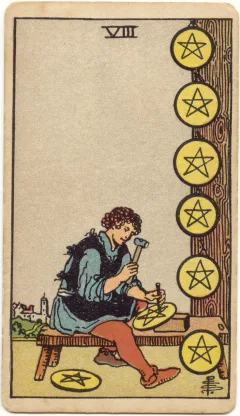
A craftsperson works carefully on one pentacle while completed pieces are displayed nearby. The repeated forms make improvement through practice the visual focus. The Eight of Pentacles explores practice and diligence. It asks what happens when attention returns to a specific skill repeatedly, with enough feedback to make repetition informative rather than merely a way to stay occupied.
Keywords
- Upright: practice, diligence.
- Reversed: perfectionism, shortcuts.
Upright meaning
Diligence involves showing up for the actual task, including its ordinary and less exciting parts. Choose a skill narrow enough to observe: a clearer explanation, a more accurate technique, or a better organized handover. Practice becomes useful when you can compare attempts and notice what changed. Consistency does not require every session to be equally productive or impressive.
Reversed meaning
Perfectionism and shortcuts can both interfere with learning. One makes finishing feel impossible; the other avoids the part that needs attention. Identify a reasonable standard for the current stage. The reversal invites practice that is honest about weaknesses without demanding flawless performance or pretending that repeated activity alone guarantees improvement.
Love
A caring relationship includes skills that can be practiced, such as listening without interruption or making a clear request. Work on one habit together if both people want to. Do not treat another person as a project whose responses should become predictable through sufficient effort.
Career
Choose a concrete area for improvement and seek feedback from someone who understands the work. A focused practice task can be more useful than broad promises to become better at everything. Keep a brief record of successive attempts so you can see which correction helped and choose the next part of the skill to practice.
Advice
Select one small skill and define a sufficient result before beginning. Make an attempt, review one useful piece of feedback, and try again. Stop at the planned endpoint so that diligence remains a workable routine rather than an endless search for a perfect version.
Yes or No
- Upright — Yes: practice, diligence.
- Reversed — Maybe: perfectionism, shortcuts.
This guide uses a fixed mapping for each orientation. Compare the listed themes with your question: where do they describe a practical opening, an obstacle, or missing information? Write down the observation that best supports your interpretation, along with any detail you still need to check.
Related spreads
Try a daily one-card reading with this prompt: "Which specific skill would benefit from another thoughtful attempt?" Write an observation from your day beside the card's theme, then choose one small action if it feels useful.
A three-card reading can add context through past, present, and future positions. Use the future position to explore how different choices could develop from your current circumstances. For a more layered question, try the Celtic Cross to compare influences and perspectives. With the Yes or No spread, start with a focused question, then compare the fixed tendency above with your own observations.
FAQ
Does the Eight of Pentacles mean working constantly?
No. Practice benefits from focus, feedback, and reasonable limits. The card's diligence theme concerns the quality and consistency of learning, not an obligation to fill every available moment with work.
What does Eight of Pentacles reversed mean?
The reversed themes are perfectionism, shortcuts. Use them to examine the situation from another angle. A reversal can highlight a difficulty, an adjustment, or a constructive response. Choose the interpretation that fits your observations and the position in the spread.
What question can I ask with Eight of Pentacles?
Ask: "Which specific skill would benefit from another thoughtful attempt?" Keep the answer connected to your own observations and choices. If the interpretation does not fit, you can set it aside rather than forcing your experience to match the card.
This AI-assisted interpretation is for entertainment only and does not predict the future. It is not medical, legal, or investment advice.