Overview and symbolism
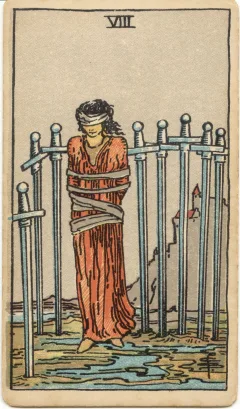
A blindfolded, loosely bound figure stands among eight swords, with open ground and a distant building visible around the scene. The image combines real obstacles with an incomplete view of the surroundings. The Eight of Swords explores restriction and self-limitation. It asks which constraints are external, which are assumptions, and what support might help you distinguish them without blaming yourself for genuine barriers.
Keywords
- Upright: restriction, self-limitation.
- Reversed: agency, release.
Upright meaning
Feeling restricted does not mean every limit is imaginary. Describe the actual conditions, including other people's authority, available resources, and commitments. Then notice any conclusion that goes beyond those facts, such as believing that no question can be asked or no small adjustment is possible. The useful distinction is between acknowledging a barrier and treating it as the entire situation.
Reversed meaning
Agency and release shift attention toward an available choice. That choice may be modest: asking for information, naming a need, or accepting help. Recognizing one available step can help you describe the remaining barriers more precisely. It invites recognition of a specific point of influence while respecting the conditions that remain outside your control.
Love
Notice whether you feel unable to express a preference and examine why. A respectful connection allows room for questions and boundaries. If a situation feels controlling or difficult to navigate, describe concrete examples to someone you trust and ask for help considering your options and boundaries.
Career
An unclear process can make a task feel impossible. Ask which requirement is fixed and where you have discretion. A colleague may be able to clarify a route you have not seen. Where a barrier requires someone else's authority, identify who can answer the question or review the requirement.
Advice
Make two lists: constraints you can verify and assumptions you want to check. Choose one assumption to investigate through a practical question. Recognizing a small option is enough; you do not need to prove unlimited freedom or solve the entire situation at once.
Yes or No
- Upright — No: restriction, self-limitation.
- Reversed — Yes: agency, release.
This guide uses a fixed mapping for each orientation. Compare the listed themes with your question: where do they describe a practical opening, an obstacle, or missing information? Write down the observation that best supports your interpretation, along with any detail you still need to check.
Related spreads
Try a daily one-card reading with this prompt: "Which limit is established, and which one have I not yet checked?" Write an observation from your day beside the card's theme, then choose one small action if it feels useful.
A three-card reading can add context through past, present, and future positions. Use the future position to explore how different choices could develop from your current circumstances. For a more layered question, try the Celtic Cross to compare influences and perspectives. With the Yes or No spread, start with a focused question, then compare the fixed tendency above with your own observations.
FAQ
Does the Eight of Swords mean my problems are all in my head?
No. External barriers can be real. The card invites careful separation of facts and assumptions, with support where needed, rather than blaming you for restrictions or demanding that positive thinking remove them.
What does Eight of Swords reversed mean?
The reversed themes are agency, release. Use them to examine the situation from another angle. A reversal can highlight a difficulty, an adjustment, or a constructive response. Choose the interpretation that fits your observations and the position in the spread.
What question can I ask with Eight of Swords?
Ask: "Which limit is established, and which one have I not yet checked?" Keep the answer connected to your own observations and choices. If the interpretation does not fit, you can set it aside rather than forcing your experience to match the card.
This AI-assisted interpretation is for entertainment only and does not predict the future. It is not medical, legal, or investment advice.