Overview and symbolism
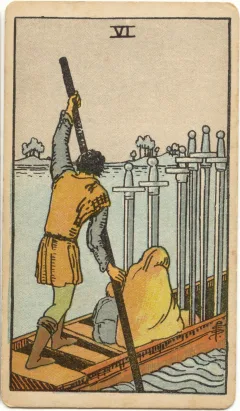
A boat carries seated figures across water, with six swords standing in the vessel and a quieter shore ahead. The carried objects make the transition feel incomplete rather than magically cleansing. The Six of Swords explores transition and perspective. It asks how a change of setting, method, or conversation can create space while acknowledging that some concerns still travel with you.
Keywords
- Upright: transition, perspective.
- Reversed: resistance, unfinished baggage.
Upright meaning
Perspective can improve when you step out of a familiar pattern long enough to describe it differently. A quieter discussion, a revised workflow, or a new arrangement may make the issue more manageable. Transition does not require pretending the earlier difficulty never happened. You can carry the learning while choosing not to repeat every part of the old approach.
Reversed meaning
Resistance and unfinished baggage may show up when the practical change has occurred but an unresolved expectation remains. Identify what still needs discussion or acknowledgment. The reversal does not mean you have failed to move on. It invites a closer look at which part of the transition is incomplete and whether support would make the next step clearer.
Love
A calmer phase may require a different way of handling disagreement, not simply a promise to stop arguing. Discuss what each person needs to leave behind and what still deserves attention. Identify one conversational habit you can change wherever you are, such as making a clear request instead of reopening an old accusation.
Career
During a handover or process change, preserve relevant context and make outstanding questions visible. A new arrangement works better when it acknowledges unfinished responsibilities. The card invites careful transition planning rather than assuming that a new team, role, or location automatically removes old difficulties.
Advice
Name one change already underway and list what is complete, what remains open, and who can help. Choose one open item to clarify. This gives movement a practical shape without requiring you to feel entirely settled before participating.
Yes or No
- Upright — Yes: transition, perspective.
- Reversed — Maybe: resistance, unfinished baggage.
This guide uses a fixed mapping for each orientation. Compare the listed themes with your question: where do they describe a practical opening, an obstacle, or missing information? Write down the observation that best supports your interpretation, along with any detail you still need to check.
Related spreads
Try a daily one-card reading with this prompt: "What needs to travel with me, and what can I leave in the old pattern?" Write an observation from your day beside the card's theme, then choose one small action if it feels useful.
A three-card reading can add context through past, present, and future positions. Use the future position to explore how different choices could develop from your current circumstances. For a more layered question, try the Celtic Cross to compare influences and perspectives. With the Yes or No spread, start with a focused question, then compare the fixed tendency above with your own observations.
FAQ
Does the Six of Swords mean leaving solves everything?
No. Its carried swords suggest that concerns and learning can accompany a transition. A new setting may offer perspective, but unresolved responsibilities or conversations still need appropriate attention.
What does Six of Swords reversed mean?
The reversed themes are resistance, unfinished baggage. Use them to examine the situation from another angle. A reversal can highlight a difficulty, an adjustment, or a constructive response. Choose the interpretation that fits your observations and the position in the spread.
What question can I ask with Six of Swords?
Ask: "What needs to travel with me, and what can I leave in the old pattern?" Keep the answer connected to your own observations and choices. If the interpretation does not fit, you can set it aside rather than forcing your experience to match the card.
This AI-assisted interpretation is for entertainment only and does not predict the future. It is not medical, legal, or investment advice.