Overview and symbolism
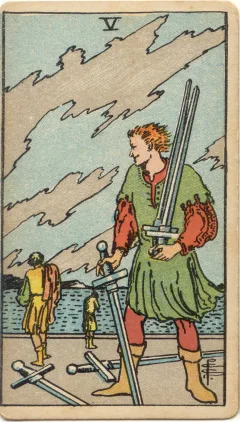
One figure gathers swords while others move away beneath an unsettled sky. The foreground position may look victorious, yet the wider scene feels disconnected. The Five of Swords explores conflict and hollow victory. It asks what winning an exchange actually achieves when trust, cooperation, or the original purpose has been lost in the effort to prevail.
Keywords
- Upright: conflict, hollow victory.
- Reversed: reconciliation, regret.
Upright meaning
Conflict becomes easier to assess when you name the desired outcome beyond being right. You might need a clear agreement, recognition of an impact, or a workable division of responsibility. Consider whether the current method serves that aim. A sharp reply can win attention while making the needed conversation harder to have.
Reversed meaning
Reconciliation and regret can invite a different response to a conflict that has already happened. Acknowledge a specific action without using the apology to demand immediate closeness. Repair may involve a changed process or a respectful distance. Ask whether the other person wants to discuss repair, and let their response guide the pace of any further conversation.
Love
Notice whether an argument has become a contest over who cares more or remembers events correctly. Return to the present need and the behavior each person can address. You can set a firm boundary without trying to humiliate the other person into agreement.
Career
A meeting can produce nominal agreement while leaving collaborators unwilling to participate. Review how decisions are reached and whether disagreement is heard fairly. If your approach contributed to the problem, name that contribution and propose a more workable way to discuss the next issue.
Advice
Before responding in a conflict, write the result you actually want. Compare the proposed message with that result. Remove any sentence whose main purpose is to score a point, while keeping the factual concern and the boundary you need to express.
Yes or No
- Upright — No: conflict, hollow victory.
- Reversed — Maybe: reconciliation, regret.
This guide uses a fixed mapping for each orientation. Compare the listed themes with your question: where do they describe a practical opening, an obstacle, or missing information? Write down the observation that best supports your interpretation, along with any detail you still need to check.
Related spreads
Try a daily one-card reading with this prompt: "What would count as a useful resolution beyond winning this argument?" Write an observation from your day beside the card's theme, then choose one small action if it feels useful.
A three-card reading can add context through past, present, and future positions. Use the future position to explore how different choices could develop from your current circumstances. For a more layered question, try the Celtic Cross to compare influences and perspectives. With the Yes or No spread, start with a focused question, then compare the fixed tendency above with your own observations.
FAQ
Does the Five of Swords mean I should let others win?
No. It asks what outcome matters and whether your method supports it. You can defend a position or boundary while declining an exchange whose only purpose has become defeating someone.
What does Five of Swords reversed mean?
The reversed themes are reconciliation, regret. Use them to examine the situation from another angle. A reversal can highlight a difficulty, an adjustment, or a constructive response. Choose the interpretation that fits your observations and the position in the spread.
What question can I ask with Five of Swords?
Ask: "What would count as a useful resolution beyond winning this argument?" Keep the answer connected to your own observations and choices. If the interpretation does not fit, you can set it aside rather than forcing your experience to match the card.
This AI-assisted interpretation is for entertainment only and does not predict the future. It is not medical, legal, or investment advice.