Overview and symbolism
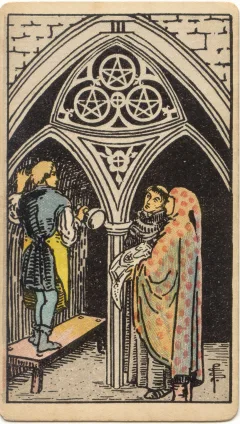
A craftsperson stands at work while two others consult nearby, with the structure around them making the shared task visible. Different roles are present in the same scene. The Three of Pentacles explores teamwork and craftsmanship. It asks how practical skill, planning, and feedback can support one another when people understand what each contributes and how their parts fit together.
Keywords
- Upright: teamwork, craftsmanship.
- Reversed: poor coordination, undervaluing skill.
Upright meaning
Craftsmanship improves through attention to the actual work and feedback that can be used. Teamwork adds the need to coordinate standards and responsibilities. Ask what a good result looks like to each participant before assuming agreement. A shared example or draft can reveal differences earlier and more constructively than a vague request for everyone to do their best.
Reversed meaning
Poor coordination and undervaluing skill may appear when decisions are made without the people who understand the task. Notice whether expertise is being heard and whether contributions are credited accurately. The reversal invites a clearer process for collaboration, not an assumption that one difficult meeting means the group cannot work together.
Love
Treat a shared practical task as an opportunity to understand each other's strengths and preferences. Agree on responsibilities rather than expecting one person to direct and inspect everything. Cooperation in a relationship benefits from appreciation of different contributions, including work that is less visible.
Career
Bring the person doing the work into discussions about scope and quality. Use concrete feedback and define who resolves disagreements. Bring one example of the work to the discussion so that each person can explain what their expertise reveals and where they need another perspective.
Advice
Choose a shared task and ask each participant to describe their responsibility and the finished result. Compare the answers for gaps or overlaps. Resolve one mismatch before adding more activity, and acknowledge the expertise that helped make the correction.
Yes or No
- Upright — Yes: teamwork, craftsmanship.
- Reversed — Maybe: poor coordination, undervaluing skill.
This guide uses a fixed mapping for each orientation. Compare the listed themes with your question: where do they describe a practical opening, an obstacle, or missing information? Write down the observation that best supports your interpretation, along with any detail you still need to check.
Related spreads
Try a daily one-card reading with this prompt: "What does each person know or do that the shared task depends on?" Write an observation from your day beside the card's theme, then choose one small action if it feels useful.
A three-card reading can add context through past, present, and future positions. Use the future position to explore how different choices could develop from your current circumstances. For a more layered question, try the Celtic Cross to compare influences and perspectives. With the Yes or No spread, start with a focused question, then compare the fixed tendency above with your own observations.
FAQ
Does the Three of Pentacles mean I should work with anyone offered?
No. It highlights the conditions that make collaboration useful: clear roles, respect for skill, and shared standards. A specific partnership still needs practical evaluation and mutual agreement.
What does Three of Pentacles reversed mean?
The reversed themes are poor coordination, undervaluing skill. Use them to examine the situation from another angle. A reversal can highlight a difficulty, an adjustment, or a constructive response. Choose the interpretation that fits your observations and the position in the spread.
What question can I ask with Three of Pentacles?
Ask: "What does each person know or do that the shared task depends on?" Keep the answer connected to your own observations and choices. If the interpretation does not fit, you can set it aside rather than forcing your experience to match the card.
This AI-assisted interpretation is for entertainment only and does not predict the future. It is not medical, legal, or investment advice.