Overview and symbolism
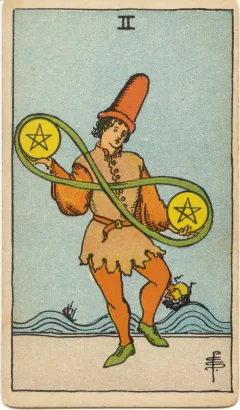
A figure balances two pentacles within a looping ribbon while ships rise and fall on waves behind them. The image suggests ongoing adjustment rather than a permanently settled arrangement. The Two of Pentacles explores adaptability and priorities. It asks how you respond when several ordinary demands compete for attention and whether your current balance depends on effort that cannot be sustained indefinitely.
Keywords
- Upright: adaptability, priorities.
- Reversed: overload, imbalance.
Upright meaning
Adaptability can mean changing the order of tasks, renegotiating a deadline, or allowing one activity to receive less attention for a while. Priorities become useful when they guide an actual choice. You do not need to give everything equal weight. Make the tradeoff explicit so that flexibility remains a deliberate response rather than a habit of absorbing every request.
Reversed meaning
Overload and imbalance may appear when the number of moving parts exceeds the time available. A better schedule cannot always solve an excessive load. Identify what can be deferred, reduced, or discussed with another person. The reversal invites an honest account of capacity rather than a demand to become more impressive at juggling.
Love
Discuss how schedules and responsibilities affect the attention you can offer each other. A change in availability deserves communication rather than an assumption that the other person will adapt silently. Small, dependable arrangements can support connection more effectively than ambitious plans that repeatedly fall through.
Career
When priorities conflict, show the tradeoff to the person responsible for deciding. Explain what can be completed within current capacity and what would need to move. Make the priority visible on a shared list, including the work that has been deferred and when you will review that decision.
Advice
Choose the two demands competing most strongly for your attention. Decide which has the greater current need and what a sufficient response to the other would look like. Communicate the adjustment to anyone affected instead of keeping the compromise invisible.
Yes or No
- Upright — Maybe: adaptability, priorities.
- Reversed — No: overload, imbalance.
This guide uses a fixed mapping for each orientation. Compare the listed themes with your question: where do they describe a practical opening, an obstacle, or missing information? Write down the observation that best supports your interpretation, along with any detail you still need to check.
Related spreads
Try a daily one-card reading with this prompt: "Which priority should guide today's tradeoff, and who needs to know?" Write an observation from your day beside the card's theme, then choose one small action if it feels useful.
A three-card reading can add context through past, present, and future positions. Use the future position to explore how different choices could develop from your current circumstances. For a more layered question, try the Celtic Cross to compare influences and perspectives. With the Yes or No spread, start with a focused question, then compare the fixed tendency above with your own observations.
FAQ
Does the Two of Pentacles mean I can handle everything?
No. Adaptability includes recognizing limits and changing commitments. Its balancing image invites review of priorities, especially when maintaining the appearance of coping requires more effort than you can reasonably sustain.
What does Two of Pentacles reversed mean?
The reversed themes are overload, imbalance. Use them to examine the situation from another angle. A reversal can highlight a difficulty, an adjustment, or a constructive response. Choose the interpretation that fits your observations and the position in the spread.
What question can I ask with Two of Pentacles?
Ask: "Which priority should guide today's tradeoff, and who needs to know?" Keep the answer connected to your own observations and choices. If the interpretation does not fit, you can set it aside rather than forcing your experience to match the card.
This AI-assisted interpretation is for entertainment only and does not predict the future. It is not medical, legal, or investment advice.