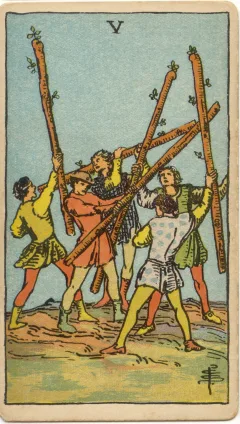
Overview and symbolism
Five figures hold wands at different angles, creating a crowded scene without an obvious shared direction. Their movements can suggest practice, rivalry, or a struggle to coordinate. The Five of Wands examines competition and friction. It asks whether the energy in a disagreement is producing useful information or simply making it difficult for anyone to understand the task.
Keywords
- Upright: competition, friction.
- Reversed: avoided conflict, compromise.
Upright meaning
Friction can reveal differences in priorities, methods, or assumptions. Name the issue before deciding that the people involved are incompatible. A structured exchange may allow competing ideas to be tested fairly. The point is not to eliminate all disagreement, but to make it possible to learn from it without turning every contribution into a contest for attention.
Reversed meaning
Avoided conflict and compromise require a closer look at what has actually been resolved. Silence may mean agreement, fatigue, or reluctance to speak. A compromise is useful when the underlying concerns have been heard. If the same issue keeps returning, ask which part was left vague rather than assuming everyone should simply move on.
Love
Describe the specific point of disagreement without collecting unrelated grievances. Each person may be defending a different need beneath the same argument. Take turns explaining those needs and look for a workable adjustment rather than trying to prove who cares more.
Career
A brainstorming session needs shared criteria and enough space for quieter participants. Competition can sharpen an idea when the rules are clear; it becomes draining when ownership and evaluation are confused. Clarify whether the meeting is for generating possibilities or choosing between them.
Advice
Write the disagreement as a neutral question that everyone could recognize. Suggest one rule for discussing it, such as finishing each person's explanation before responding. Notice whether this changes the quality of the exchange even if the conclusion remains open.
Yes or No
- Upright — No: competition, friction.
- Reversed — Maybe: avoided conflict, compromise.
This guide uses a fixed mapping for each orientation. Compare the listed themes with your question: where do they describe a practical opening, an obstacle, or missing information? Write down the observation that best supports your interpretation, along with any detail you still need to check.
Related spreads
Try a daily one-card reading with this prompt: "What are we actually disagreeing about, and how can we discuss it clearly?" Write an observation from your day beside the card's theme, then choose one small action if it feels useful.
A three-card reading can add context through past, present, and future positions. Use the future position to explore how different choices could develop from your current circumstances. For a more layered question, try the Celtic Cross to compare influences and perspectives. With the Yes or No spread, start with a focused question, then compare the fixed tendency above with your own observations.
FAQ
Is the Five of Wands always a bad sign?
No. Friction can expose useful differences when people have a fair way to discuss them. The card invites attention to the process of disagreement rather than predicting a fight.
What does Five of Wands reversed mean?
The reversed themes are avoided conflict, compromise. Use them to examine the situation from another angle. A reversal can highlight a difficulty, an adjustment, or a constructive response. Choose the interpretation that fits your observations and the position in the spread.
What question can I ask with Five of Wands?
Ask: "What are we actually disagreeing about, and how can we discuss it clearly?" Keep the answer connected to your own observations and choices. If the interpretation does not fit, you can set it aside rather than forcing your experience to match the card.
This AI-assisted interpretation is for entertainment only and does not predict the future. It is not medical, legal, or investment advice.