Overview and symbolism
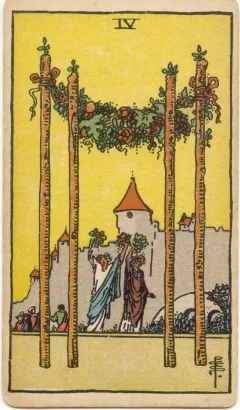
Four upright wands support a garland, while figures celebrate near a larger gathering and buildings in the background. The open frame makes the scene feel like an entrance to shared space. The Four of Wands concerns celebration and belonging. It asks how a milestone can be acknowledged in a way that makes participation welcoming rather than turning the occasion into another performance.
Keywords
- Upright: celebration, belonging.
- Reversed: instability, exclusion.
Upright meaning
Celebration can be simple and specific. Thank the people who helped, mark the completion of a stage, or make time to enjoy a shared place. Belonging grows through repeated experiences of being included. Notice what makes an environment comfortable enough for people to contribute without having to guess whether they are welcome.
Reversed meaning
Instability and exclusion ask whose experience is missing from the apparent celebration. A group can look harmonious while some members feel peripheral or overburdened. Consider whether the arrangement depends on invisible effort. A small change in invitations, access, or responsibilities may make the shared space more genuinely welcoming.
Love
Appreciate an ordinary milestone together without comparing it with someone else's relationship timeline. If you share a home or regular gathering place, discuss what helps each person feel at ease. Choose a ritual that reflects your own connection and makes room for the people you want to include.
Career
Acknowledge a completed phase before the next deadline erases it. Give credit to quieter contributions as well as visible ones. A useful team ritual should include people who work differently and should not create pressure to perform enthusiasm or disclose more than they want to.
Advice
Plan a modest way to recognize shared effort. Ask who should be included and what would make participation comfortable. Keep the gesture aligned with the actual achievement so that appreciation feels concrete rather than obligatory.
Yes or No
- Upright — Yes: celebration, belonging.
- Reversed — Maybe: instability, exclusion.
This guide uses a fixed mapping for each orientation. Compare the listed themes with your question: where do they describe a practical opening, an obstacle, or missing information? Write down the observation that best supports your interpretation, along with any detail you still need to check.
Related spreads
Try a daily one-card reading with this prompt: "How can this milestone be celebrated in a way that includes everyone involved?" Write an observation from your day beside the card's theme, then choose one small action if it feels useful.
A three-card reading can add context through past, present, and future positions. Use the future position to explore how different choices could develop from your current circumstances. For a more layered question, try the Celtic Cross to compare influences and perspectives. With the Yes or No spread, start with a focused question, then compare the fixed tendency above with your own observations.
FAQ
Does the Four of Wands always mean marriage?
No. It can describe celebration, a welcoming environment, or a shared milestone of many kinds. It does not predict a wedding or make partnership the only route to belonging.
What does Four of Wands reversed mean?
The reversed themes are instability, exclusion. Use them to examine the situation from another angle. A reversal can highlight a difficulty, an adjustment, or a constructive response. Choose the interpretation that fits your observations and the position in the spread.
What question can I ask with Four of Wands?
Ask: "How can this milestone be celebrated in a way that includes everyone involved?" Keep the answer connected to your own observations and choices. If the interpretation does not fit, you can set it aside rather than forcing your experience to match the card.
This AI-assisted interpretation is for entertainment only and does not predict the future. It is not medical, legal, or investment advice.