Overview and symbolism
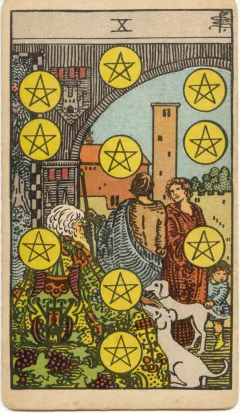
Several generations, animals, and buildings share a busy scene framed by ten pentacles. The image places individual lives within a larger structure of continuity. The Ten of Pentacles explores legacy and stability. It asks what is passed on through habits, knowledge, and shared arrangements, and whether those structures remain useful to the people who live with them now.
Keywords
- Upright: legacy, stability.
- Reversed: family tension, instability.
Upright meaning
Legacy can be ordinary: a dependable practice, a skill taught patiently, or a record that helps someone continue the work. Stability involves making support less dependent on one person's constant presence. Consider what you want to preserve and how to make it understandable to others. A durable arrangement also needs room to adapt when participants or circumstances change.
Reversed meaning
Family tension and instability can arise when inherited expectations no longer fit current needs. Name the specific disagreement instead of treating the whole history as either ideal or harmful. The reversal invites attention to who has a voice in maintaining or revising a shared structure. Continuity is more meaningful when participation is not confused with unquestioning compliance.
Love
Discuss traditions and long term expectations without assuming that everyone defines family or commitment in the same way. A stable connection allows people to understand the agreements they are joining. Ask which traditions feel supportive to each person and which expectations would need to be adapted for a shared life.
Career
Make useful knowledge accessible through documentation, mentoring, or a clear handover. A team becomes less fragile when routine work does not depend on one person's memory. Ask a colleague to use the handover notes and point out anything that still depends on knowledge you have not written down.
Advice
Choose one practice or piece of knowledge worth passing on. Write it clearly enough that another person could use it, and invite them to suggest an improvement. This turns legacy into a living contribution rather than a rule preserved only because it is old.
Yes or No
- Upright — Yes: legacy, stability.
- Reversed — Maybe: family tension, instability.
This guide uses a fixed mapping for each orientation. Compare the listed themes with your question: where do they describe a practical opening, an obstacle, or missing information? Write down the observation that best supports your interpretation, along with any detail you still need to check.
Related spreads
Try a daily one-card reading with this prompt: "What is worth preserving, and how can others help it remain useful?" Write an observation from your day beside the card's theme, then choose one small action if it feels useful.
A three-card reading can add context through past, present, and future positions. Use the future position to explore how different choices could develop from your current circumstances. For a more layered question, try the Celtic Cross to compare influences and perspectives. With the Yes or No spread, start with a focused question, then compare the fixed tendency above with your own observations.
FAQ
Does the Ten of Pentacles predict an inheritance?
No. Its legacy theme is symbolic and can concern knowledge, routines, and relationships. It does not forecast financial events or provide advice about inheritance, property, or investments.
What does Ten of Pentacles reversed mean?
The reversed themes are family tension, instability. Use them to examine the situation from another angle. A reversal can highlight a difficulty, an adjustment, or a constructive response. Choose the interpretation that fits your observations and the position in the spread.
What question can I ask with Ten of Pentacles?
Ask: "What is worth preserving, and how can others help it remain useful?" Keep the answer connected to your own observations and choices. If the interpretation does not fit, you can set it aside rather than forcing your experience to match the card.
This AI-assisted interpretation is for entertainment only and does not predict the future. It is not medical, legal, or investment advice.