Overview and symbolism
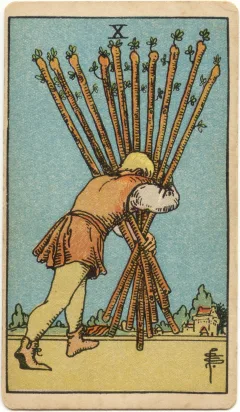
A figure carries a large bundle of wands toward buildings in the distance, with the load obscuring much of the view ahead. The image makes responsibility tangible and awkward. The Ten of Wands examines burden: not only how much you carry, but whether carrying everything yourself has made it harder to see what the work is for.
Keywords
- Upright: burden, responsibility.
- Reversed: release, delegation.
Upright meaning
Responsibility can be meaningful while still exceeding a reasonable share. Identify the tasks, expectations, and invisible coordination that make up the load. Some may genuinely belong to you; others may have accumulated because nobody discussed ownership. Naming the components can reveal where a clearer agreement would help more than another attempt to become endlessly efficient.
Reversed meaning
Release and delegation shift attention toward redistributing the burden. Letting go of a task requires clarity about what is being transferred and what support the next person needs. The reversal does not mean dropping every commitment. It invites a considered distinction between what must be completed, what can be shared, and what no longer serves a purpose.
Love
Discuss the work of maintaining a shared life, including planning and remembering. One person's apparent competence can hide an uneven arrangement. Ask for a specific redistribution rather than waiting until resentment forces the conversation or assuming that care requires carrying every responsibility silently.
Career
Make workload visible to the person who sets priorities. Explain which task would need to move if another is added. Delegation works best with clear outcomes and reasonable authority, not when you retain every decision while handing someone else the activity.
Advice
Write every current commitment on one page. Mark what is essential, shared, optional, or outdated. Choose one item to clarify or redistribute through a direct conversation. Keep the discussion about capacity and ownership rather than proving who works hardest.
Yes or No
- Upright — No: burden, responsibility.
- Reversed — Maybe: release, delegation.
This guide uses a fixed mapping for each orientation. Compare the listed themes with your question: where do they describe a practical opening, an obstacle, or missing information? Write down the observation that best supports your interpretation, along with any detail you still need to check.
Related spreads
Try a daily one-card reading with this prompt: "Which part of this burden needs a clearer owner or a smaller scope?" Write an observation from your day beside the card's theme, then choose one small action if it feels useful.
A three-card reading can add context through past, present, and future positions. Use the future position to explore how different choices could develop from your current circumstances. For a more layered question, try the Celtic Cross to compare influences and perspectives. With the Yes or No spread, start with a focused question, then compare the fixed tendency above with your own observations.
FAQ
Does the Ten of Wands mean hard work is pointless?
No. It asks whether the load is proportionate and appropriately shared. Meaningful responsibility can remain valuable while the way it is organized needs to change.
What does Ten of Wands reversed mean?
The reversed themes are release, delegation. Use them to examine the situation from another angle. A reversal can highlight a difficulty, an adjustment, or a constructive response. Choose the interpretation that fits your observations and the position in the spread.
What question can I ask with Ten of Wands?
Ask: "Which part of this burden needs a clearer owner or a smaller scope?" Keep the answer connected to your own observations and choices. If the interpretation does not fit, you can set it aside rather than forcing your experience to match the card.
This AI-assisted interpretation is for entertainment only and does not predict the future. It is not medical, legal, or investment advice.