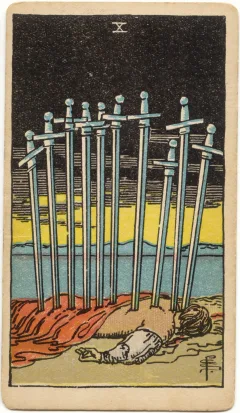
Overview and symbolism
A figure lies beneath ten swords while a band of light appears along the distant horizon. The dramatic image can feel alarming, but it is read here symbolically. The Ten of Swords explores ending and exhaustion: the point at which continuing the same account or effort no longer seems workable. The image concentrates the feeling of reaching a limit into one unmistakable scene.
Keywords
- Upright: ending, exhaustion.
- Reversed: recovery, renewal.
Upright meaning
An ending may involve acknowledging that a particular plan has reached its limit. Name what is actually finished instead of extending that conclusion to every part of your life. Exhaustion can make a local setback feel total. A more precise description leaves room to identify immediate needs, unfinished responsibilities, and support without demanding instant optimism.
Reversed meaning
Recovery and renewal may begin with a small reduction in pressure rather than a dramatic turnaround. You might complete a closing task, ask someone to share responsibility, or allow an ordinary routine to become simpler. Notice small changes in what feels manageable from one day to another. It invites attention to what helps you reengage at a pace suited to your circumstances.
Love
If a painful pattern has reached a limit, describe that limit plainly. Ask what each person needs before deciding which conversation or practical step comes next. Decisions about a connection require real communication, boundaries, and practical information, especially when fatigue makes every option feel overwhelming.
Career
A failed approach can be closed without treating it as a verdict on your whole ability. Record the lesson, communicate what remains, and avoid repeatedly reopening the same unworkable plan. Seek support with the practical transition rather than assuming that you must personally carry every consequence.
Advice
Write a narrow statement of what has ended and a separate list of what remains available. Choose one immediate, manageable task from the second list. If exhaustion or distress persists, consult a qualified professional and explain how it affects your ordinary routines, attention, and capacity to manage daily responsibilities.
Yes or No
- Upright — No: ending, exhaustion.
- Reversed — Maybe: recovery, renewal.
This guide uses a fixed mapping for each orientation. Compare the listed themes with your question: where do they describe a practical opening, an obstacle, or missing information? Write down the observation that best supports your interpretation, along with any detail you still need to check.
Related spreads
Try a daily one-card reading with this prompt: "What has actually ended, and what am I mistakenly treating as finished too?" Write an observation from your day beside the card's theme, then choose one small action if it feels useful.
A three-card reading can add context through past, present, and future positions. Use the future position to explore how different choices could develop from your current circumstances. For a more layered question, try the Celtic Cross to compare influences and perspectives. With the Yes or No spread, start with a focused question, then compare the fixed tendency above with your own observations.
FAQ
Does the Ten of Swords predict physical harm?
No. Its dramatic imagery is used only as a metaphor for endings and exhaustion. It does not predict injury, death, or any specific event and should not be treated as a warning of harm.
What does Ten of Swords reversed mean?
The reversed themes are recovery, renewal. Use them to examine the situation from another angle. A reversal can highlight a difficulty, an adjustment, or a constructive response. Choose the interpretation that fits your observations and the position in the spread.
What question can I ask with Ten of Swords?
Ask: "What has actually ended, and what am I mistakenly treating as finished too?" Keep the answer connected to your own observations and choices. If the interpretation does not fit, you can set it aside rather than forcing your experience to match the card.
This AI-assisted interpretation is for entertainment only and does not predict the future. It is not medical, legal, or investment advice.